
 Author: Jefferson Jay Cheney
While sometimes considered political rhetoric, tort reform is real. However, it is slow and far from uniform across jurisdictions. In recent years, some state legislatures across the country have continued to plug away at enacting reforms aimed at addressing Nuclear Verdicts® and broader concerns around social inflation. Social inflation generally describes the increase of insurance claims payouts and loss ratios due to non-economic factors resulting from the high costs of liability litigation.[i] Public distrust of large corporations, widespread use of social media, and shifting social attitudes around justice held by a changing demographic all play a role in social inflation.[ii] But these factors are not the true driving force behind the number one cause of social inflation: Nuclear Verdicts®. And as a result, tort reform falls short in solving the biggest challenge facing the insurance industry. Multiple states have attempted to address various aspects of civil litigation exposure through statutory reform.
In 2023, Florida enacted H.B. 837[iii], codified in various statutes which dealt with, in part, comparative fault[iv] and shortened limitations timeframes in negligence cases[v]. In 2025, Georgia enacted S.B. 68[vi], codified in multiple state statutes addressing tort procedure[vii], damages proof[viii], seat-belt evidence[ix], negligent security liability[x], noneconomic damages evidence[xi], recovery of special damages for medical and healthcare expenses[xii], and third-party litigation-funding[xiii]. Often, the focus of tort reform legislation efforts tends to be on proportional liability, noneconomic damage caps, procedural screening requirements, litigation funding transparency, and, in some jurisdictions, anti-anchoring measures.
Legislative efforts largely attempt to manage downstream effects of social inflation. But while tort reform may modify procedures, evidentiary boundaries, damages caps, and even help reveal litigation funding, it does not eliminate the potential for a disproportionate outcome or fundamentally change the emotional and psychological drivers underlying Nuclear Verdicts®.
A persistent and dangerous mindset in claims handling is believing that reform jurisdictions are inherently safer jurisdictions. In so-called reform states, claims teams may fall into the same predictable traps which include under-reserving, delaying meaningful engagement, and treating statutory caps as a back-end safety net. By contrast, in jurisdictions with fewer statutory tort reforms perceived as more dangerous, elevated risk may drive a more disciplined early case assessment, earlier escalation, and faster movement toward resolution. The mindset, not a statute, determines the outcome.
Whatever the benefits of tort reform efforts, it is a mistake to assume statutory reforms are the end-all, be-all solution. This mistake leads to shock and surprise when a jury in a “reform state” returns a nine-figure verdict. Tort reform is not strategy. For example, damages caps are not strategy. Rather, they are a constraint applied at the end of a process that is largely driven by human perceptions and psychology. Indeed, jurisdictional tort reforms may alter some litigation mechanics. However, reforms do not change or negate the underlying, number one driver of Nuclear Verdicts®: juror anger.
Put simply: statutory reforms do not change human psychology. Jurors do not evaluate cases through the lens of tort reform. They evaluate conduct, people, and perceived accountability in the ways humans make decisions. A jury in a reformed state can still return a verdict that reflects rage at a defendant who appeared indifferent, even if the verdict may later be reduced to a statutory cap (which may still be nuclear!). Treating reform as protection from exposure rather than a variable will not change the volatility which exists and may actually contribute to the problem of Nuclear Verdicts® and higher than reasonable value settlements. Relying on, and waiting for, tort reform is not strategy. Claims teams need strategy now.
Beyond Tort Reform: The Apex℠
The insurance industry has historically treated Nuclear Verdicts® as a legal system problem and persistently recommends tort reforms as a solution.[xiv] They are not. They could be aptly characterized as a human reaction problem driven by perceived indifference, avoidance, and a perceived lack of accountability, all which fuel anger. As one paper observed, “Many Americans are angry at big companies and the jury box is perhaps the only place they can punish them for bad behavior.”[xv] While reform may change the rules, it does not change jurors or address the anger driving disproportionate and unfair awards. What claims teams need now are strategies that directly address how jurors will evaluate conduct, responsibility, credibility, and whether the defense appears human and reasonable. Strategies which influence human dynamics that drive anger long before a jury completes a verdict form are crucial and they are available – right now.
Nuclear Verdicts® are not isolated incidents. They are a systemic condition which continues to spread through the litigation environment, producing escalating severity, distorted valuations, and operational instability across the claims industry. Like any serious condition, effective treatment begins with accurate diagnosis.
Developed through the thorough analysis of more than 100 real Nuclear Verdicts®, The Apex℠ is just what the doctor ordered. It is a data-backed, trial-tested method of defense strategies which focus on identifying and defusing anger across the life of a claim through thorough evaluation, early alignment, disciplined communication, narrative control, and credibility-building decision making. The Apex℠ is a methodical approach which empowers defense and claims teams to tackle the primary emotion driving Nuclear Verdicts®: anger.[xvi]
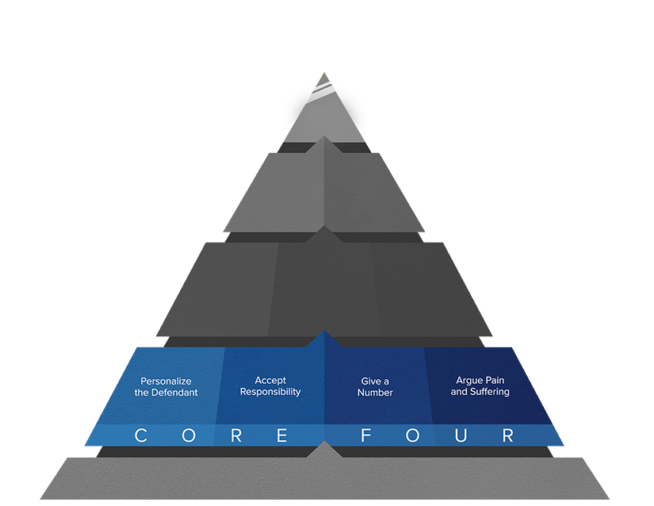
At the center of The Apex℠ is the Core Four:
- Personalize the Defendant – The defense must tell a real, human story to ensure the entity or corporate defendant is perceived as real people, not a faceless entity ripe for punishment.
- Accept Responsibility – The defense must accept responsibility, not necessarily liability, for something in every case, even while seeking a defense verdict. The easiest way to defuse anger is by validating it, and accepting responsibility allows jurors to hear and truly listen from a place of reasonableness and common sense.
- Give a Number – The defense must provide a (real, credible, supported) defense number early and often, instead of surrendering the conversation to plaintiffs’ anchoring tactics.
- Argue Pain & Suffering – The defense must address the biggest damages component of Nuclear Verdicts® by arguing both the impact of the incident on the plaintiff and the impact of money on the plaintiff. By “showing our work” when it comes to damages, the defense has an opportunity to deliver justice for all, including the plaintiff.
The Core Four principles underlying The Apex℠ are not reserved for trial. They are practical strategies that must influence claim evaluation, communication, documentation, reserving, and resolution decisions from the outset of a claim. The focus should not only be on liability, but on confronting the question at the very beginning of a claim: “What will drive anger?” Damages caps and procedural reforms are beneficial, but they should be considered as back-end controls, not front-end strategy.
What Claims Teams Should Change Now
Claims teams cannot afford to wait for the next legislative session, the next reform package, or the hope that “tomorrow” will solve today’s exposure problems. As the old country song reminds us, “if tomorrow never comes,”[xvii] relying on future reform rather than present, disciplined strategies available now will only result in unpreparedness when the next Nuclear Verdict® arrives.
Operationally, claims professionals must move quickly, communicate with acknowledgment and accountability, look for facts that personalize the defendant early, and partner with defense counsel to deploy The Apex℠ early and (you guessed it!) often.
Social inflation is unlikely to disappear simply because legislatures enact procedural reforms. Juror distrust, emotional decision-making, and anger toward perceived corporate indifference will linger as powerful forces in litigation. Unlike tort reform statutes which exist today or those which may arrive tomorrow or next year, The Apex℠ can be used immediately to address the psychological and emotional conditions that fuel Nuclear Verdicts®. Although statutory reforms may provide some legal guardrails after a verdict is rendered, The Apex℠ is designed to reduce the likelihood of a Nuclear Verdict® occurring in the first place. And Apex Defense Consulting can equip claims teams and defense counsel to do that in every claim, now.[xviii]
Keep Reading
 Getting to Verdict One Issue at a Time
 The Scariest Thing This Halloween: Nuclear Verdicts®!
 A Fall Without a Proven Cause: Causation and the Duty to Preserve Surveillance Footage in Weathers v. John C. Choe, DDS, Inc.
 Special Report: Five Key Takeaways on Florida Plaintiff Tactics
 Plaintiffs’ Attempts to Expedite an Appeal Gone Wrong: Maniago v. Desert Cardiology Consultants’ Medical Group, Inc.
 Good Record-Keeping is the Best Medicine
 Confidential Does Not Mean AI-Proof: Updating Protective Orders for AI
 The Arizona Pocket Fire: Do Not Wait for the Flames, Act Now!
 The Reason for Reason
Sources
[i] Nat’l Ass’n of Ins. Comm’rs, Ctr. for Ins. Pol’y & Rsch., Regulator Insight: Social Inflation 1 (Jan. 2023).
[ii] Id.
[iii] H.B. 837, 2023 Leg., Reg. Sess. (Fla. 2023).
[iv] Fla. Stat. § 768.81 (2025).
[v] Fla. Stat. § 95.11(5)(a) (2025).
[vi] S.B. 68, 2025 Gen. Assemb., Reg. Sess. (Ga. 2025).
[vii] O.C.G.A. § 9-11-12 (2025).
[viii] O.C.G.A. § 9-11-42 (2025).
[ix] O.C.G.A. § 40-8-76.1 (d)(1) (2025).
[x] O.C.G.A. § 51-3-51 (2025).
[xi] O.C.G.A. § 9-10-184 (2025).
[xii] O.C.G.A. § 51-12-1.1 (2025).
[xiii] O.C.G.A. § 7-10-4 (2025).
[xiv] U.S. Chamber of Com. Inst. for Legal Reform, Nuclear Verdicts – Trends, Causes, and Solutions 4 (Sept. 2022).
[xv] Richard Vanderford, “Nuclear” Jury Verdicts Rise Alongside American Anger, Wall St. J. (July 8, 2024, 5:30 AM ET), https://www.wsj.com/articles/nuclear-jury-verdicts-rise-alongside-american-anger-f63b94b3.
[xvi] Robert F. Tyson, Jr. & Cayce E. Lynch, Nuclear Verdicts: The Apex – Break the Pattern 26 (Law Dog Publ’g, LLC 2025).
[xvii] Garth Brooks, If Tomorrow Never Comes, on Garth Brooks (Capitol Records 1989).
[xviii] Apex Defense Consulting is a consulting firm and education platform focused on helping insurance carriers, claims teams, and defense counsel to reduce exposure and risk through expert guidance, on-demand education, industry-wide collaboration, and tailored defense strategy. Apex Def. Consulting, About Apex Defense Consulting, https://apexdefenseconsulting.com/ (last visited May 19, 2026).