
 Author: Michel Anastassiou
 Editor: Dr. Alexandra McDermott
The Apex℠ Starts Long Before Trial
The Apex℠ was developed to combat Nuclear Verdicts®, but one of its most valuable lessons extends far beyond the courtroom. The same principles that reduce verdict exposure can also prevent nuclear settlements improve mediation outcomes, and create more productive negotiations throughout the life of a case. Few principles illustrate that lesson better than giving a number.
If you mention the concept of “giving a number” in a room full of defense lawyers, claims professionals, or corporate representatives, familiar concerns quickly emerge. Won’t that weaken our defense? Won’t that legitimize the claim? Won’t the jury view our number as an admission? Sometimes the concern has little to do with trial strategy and everything to do with comfort.
Those concerns are understandable. They are also focused on the wrong risk. The real danger is not giving a number. The real danger is allowing someone else to be the only person in the room willing to discuss one.
The damages conversation does not disappear because the defense refuses to participate in it. Plaintiff’s counsel still provides a number, narrative, and framework. The only question is whether the defense chooses to lead that conversation or surrender it. In that sense, giving a number is not merely a trial tactic. It is a leadership strategy.
Before We Give a Number, We Must Understand What We Are Giving a Number For
Imagine selecting twelve strangers from different walks of life and placing them in a room together. Then give them a series of problems. A six-month-old Mercedes-Benz worth $80,000 is damaged in a collision. The owner later undergoes surgery resulting in $160,000 in hospital bills and $90,000 in physical therapy expenses. He misses two months of work earning $12,000 per month. How much money is required to make him whole?
The discussion may not be perfect, but most people know where to begin. The vehicle can be inspected. The repair costs can be estimated. The medical expenses can be reviewed. The wage loss can be calculated. There are records, invoices, experts…handrails.
Now ask the real questions: What is the value of missing your daughter’s championship game while recovering from surgery? What is the value of watching your son learn to ride a bicycle from a living room window because you could not walk outside? What is the value of fear? Anxiety? Frustration? A life that no longer feels quite the same as it once did?
Suddenly the room becomes quiet. Not because people do not care; because they do.
And because they have been asked to solve a problem with no invoice, no formula, and no universally accepted answer. The economic damages have handrails, but pain and suffering does not. That reality matters because it is precisely where jurors become most vulnerable to influence.
The Psychology of Uncertainty
Behavioral psychologists Amos Tversky and Daniel Kahneman spent decades studying how people make decisions under uncertainty. Their research revealed that when individuals face difficult questions without clear answers, they naturally search for a starting point. They look for guidance. They look for a framework. They look for someone willing to help them solve the problem.¹
Jurors are no different. Neither are mediators, plaintiffs, or claims professionals evaluating settlement authority. Human beings naturally seek reference points when uncertainty exists. That reality helps explain why plaintiff’s counsel almost always gives a number. A number does more than communicate a request. A number provides a roadmap and creates an anchor.
Research confirms the power of anchoring in jury decision-making. One study specifically examined the concern that a defense counter-anchor might be viewed as a concession of liability and found no evidence that offering a lower damages figure adversely affected liability determinations.² The fear that has prevented many defense attorneys from discussing damages may be misplaced.
The Data Is Difficult to Ignore
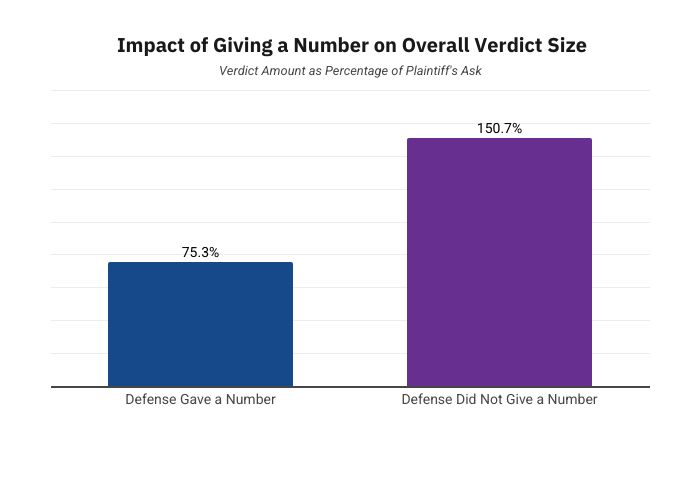
The Apex℠ analysis of one hundred Nuclear Verdicts® reached a similar conclusion. When the defense provided a damages framework, verdicts averaged approximately 75.3% of the plaintiff’s demand, but when the defense remained silent, verdicts averaged approximately 150.7% of the plaintiff’s demand.⁴
Meet Mark
Imagine the case does not settle. Discovery is complete, experts have been retained, and mediation comes and goes without resolution. What happens next? The case proceeds to trial.
Here are the facts: Greg, a commercial delivery driver, glances away from the roadway and rear-ends Mark Reynolds. Liability is not seriously disputed. Mark undergoes cervical surgery, incurring approximately $250,000 in medical expenses. He misses two months of work, where he earns $12,000 per month.
At closing argument, plaintiff’s counsel asks the jury for $10 million. Approximately $274,000 consists of medical expenses and wage loss. The remaining $9.7 million is attributed to pain and suffering, emotional distress, inconvenience, anxiety, loss of enjoyment of life, and future harm. The defense does not address damages, leaving the jury with just one framework by which to assess damages—and it is not favorable to the defense.
What Leadership Looks Like
Many defense lawyers mistakenly believe they must choose between accepting responsibility and defending the case.
Acknowledging the plaintiff’s suffering strengthens the case, believe it or not. It demonstrates accountability and validates the plaintiff’s experience. Most importantly, it removes plaintiff counsel’s most effective psychological weapon: anger.
Once the defense establishes itself as the most reasonable voice in the courtroom, it can begin helping jurors solve the problem they were sent to solve.
“Ladies and gentlemen, your task is not to punish anyone. Your task is to fairly compensate Mark for the harm proven by the evidence. The medical expenses are approximately $250,000. The wage loss is approximately $24,000. Those figures come from records, testimony, and expert opinions. The harder question is pain and suffering. No witness can hand you an invoice for anxiety. No expert can calculate the value of a missed family memory. We believe a verdict of $1 million or less fairly compensates Mark for the harm proven by the evidence. Mark testified that what keeps him awake at night is uncertainty about his future and his ability to continue being the husband, father, and provider he was before this collision. A fair award of one million dollars or less cannot give back the moments he missed or erase the challenges he has faced, but it can acknowledge those losses, provide financial security, support his continued recovery, and perhaps most importantly, give him hope that this collision does not define the rest of his life.”
The defense is not minimizing harm or bargaining with the jury. Instead, the defense is helping jurors understand what fair compensation looks like. By acknowledging Mark’s losses while also recognizing his future, the defense provides something often missing from damages discussions: hope. Plaintiff’s counsel naturally focuses on what was taken away. The Apex℠ allows the defense to acknowledge those losses while demonstrating that fair compensation can provide security, stability, and a path forward. In doing so, the defense becomes the most reasonable voice in the courtroom, validates plaintiff’s emotions, and takes control of the damages conversation.
Even When Seeking a Defense Verdict?!
Conventional wisdom suggests discussing damages undermines a defense verdict request, but data from Nuclear Verdicts®: The Apex – Break the Pattern suggests otherwise. In the 100 cases analyzed, defendants who provided a damages framework achieved substantially better outcomes than defendants who remained silent—even when seeking a complete defense verdict.
When defendants gave a number, verdicts averaged approximately 66% of the plaintiff’s demand. Compared to 200.2% of the plaintiff’s demand, when defendants gave no number.⁴
Four Rules for Giving a Number
For giving a number to work and provide a complete defense, it must follow certain rules.
Give it early. Maybe as early as jury selections. Jurors remember first impressions.
Give it often. Credibility grows through consistency.
Ensure it never goes up. Credibility is difficult to earn and easy to lose.
Make it reasonable. The number must be grounded in the evidence and consistent with the defense theme.
Takeaway
Giving a number allows the defense to shape the damages conversation, weaving it into the larger defense story. Jurors need that guidance when confronting the most difficult questions in a case. A reasonable damages framework grounded in evidence reduces confusion, defuses anger, and ensures jurors reach a just result. The defense must take control of the damages conversation from the day the file is opened through mediation, settlement negotiations, and, if necessary, trial.
Keep Reading
 Getting to Verdict One Issue at a Time
 The Scariest Thing This Halloween: Nuclear Verdicts®!
 A Fall Without a Proven Cause: Causation and the Duty to Preserve Surveillance Footage in Weathers v. John C. Choe, DDS, Inc.
 Special Report: Five Key Takeaways on Florida Plaintiff Tactics
 Plaintiffs’ Attempts to Expedite an Appeal Gone Wrong: Maniago v. Desert Cardiology Consultants’ Medical Group, Inc.
 Good Record-Keeping is the Best Medicine
 Confidential Does Not Mean AI-Proof: Updating Protective Orders for AI
 The Arizona Pocket Fire: Do Not Wait for the Flames, Act Now!
 The Reason for Reason
Sources
- Amos Tversky & Daniel Kahneman, Judgment Under Uncertainty: Heuristics and Biases, 185 Science 1124, 1128–30 (1974).
- John Campbell, Bernard Chao, Christopher Robertson & David Yokum, Countering the Plaintiff’s Anchor: Jury Simulations to Evaluate Damages Arguments, 101 Iowa L. Rev. 543, 543–44, 575–76 (2016). The authors specifically examined the concern that defense counter-anchors might be interpreted as concessions of liability and found no evidence supporting that fear.
- Daniel Kahneman, Thinking, Fast and Slow 119–28 (2011).
- Robert F. Tyson, Jr. & Cayce E. Lynch, Nuclear Verdicts®: Defending Justice for All 200, 204 (2024).